
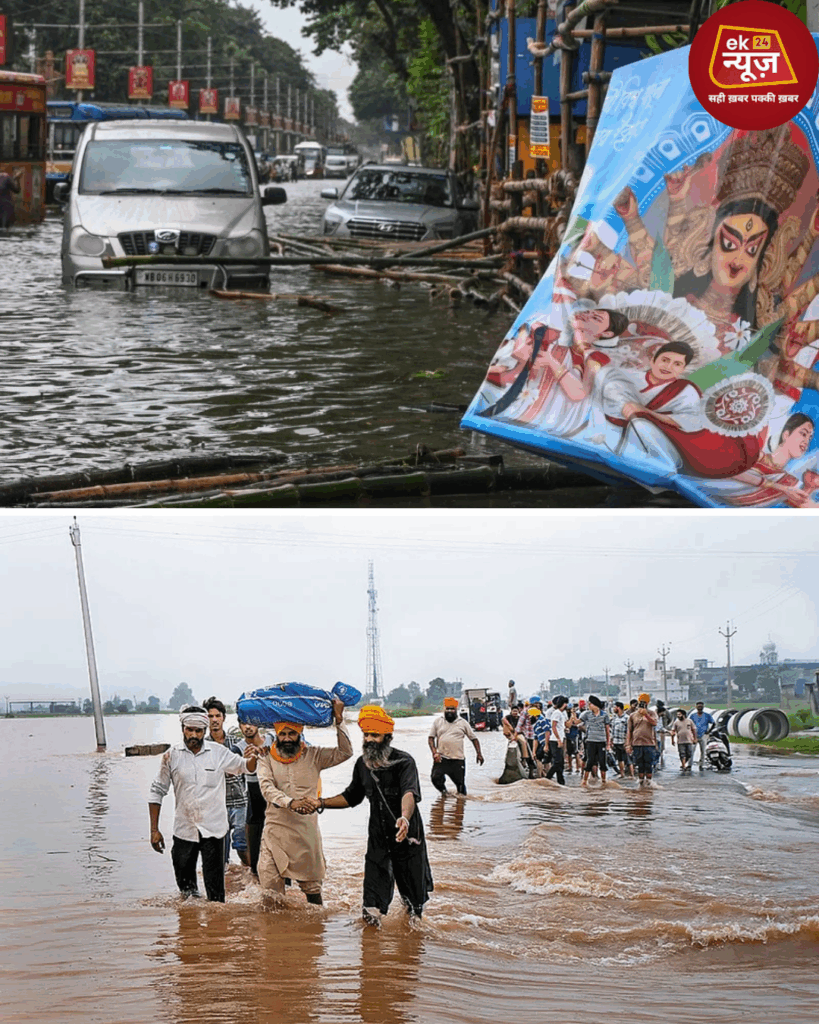
From the farmlands of Punjab, where swollen rivers have swept through villages, to the streets of Kolkata, now drowning under waist-deep water, India is living through one of its most extraordinary monsoon seasons in memory. What began as heavy showers in the north has cascaded into a trail of destruction across the east, leaving thousands displaced and millions anxious about what comes next.
In Punjab, families are wading through flooded homes, farmers are watching their paddy fields vanish under torrents of water, and roads are cut off as rivers continue to rise. Moving east, the fear is no less real. On Friday, a sudden cloudburst over Kolkata brought the bustling city to a standstill — major roads were submerged, transport collapsed, and homes filled with floodwater. At least a dozen people lost their lives, while rescue teams continue to work tirelessly ahead of the festive season.
But beyond the devastation on the ground lies a startling shift in the skies. For the first time in recorded history, the southwest monsoon has crossed the Himalayas and entered Tibet. Meteorologists are calling it a “climatic re-mapping of South Asia.” This unprecedented movement is expected to alter rainfall patterns across northern and eastern India, intensify river flows in the Himalayan foothills, and potentially impact agriculture, water reservoirs, and even glacier-fed river systems. Experts warn that states like Bihar, Uttar Pradesh, and Jharkhand, already prone to floods, could face heightened risks in the weeks ahead.
The India Meteorological Department (IMD) has cautioned that Bihar’s rivers — Gandak, Kosi, and Bagmati — may rise sharply due to this unusual monsoon trajectory. “Bihar sits on the frontline of monsoon extremes,” explained Dr R. Kumar, a Patna-based climate researcher. “Cross-Himalayan currents are changing the way rainfall is distributed in South Asia, which could have long-term consequences for agriculture, water management, and disaster preparedness.”
Relief efforts are underway — from reinforcing embankments in Bihar to pumping floodwater out of Kolkata. Yet, behind every statistic lies a family forced from their home, a farmer staring at a ruined crop, or a child wading through murky floodwater.
This monsoon milestone — Punjab’s fields under water, Kolkata’s streets submerged, Bihar bracing for the worst, and rains leaping over the Himalayas — is more than just a weather event. It serves as a reminder that India’s climate reality is shifting, and with it, millions of lives are being transformed.